
we're not ok
This is small reliefs, a new weekly(ish) email dispatch from me, Amanda. If you'd rather not receive these emails or got this one by mistake, no worries. Unsubscribe via the link at the end of this email anytime.
It’s the second Monday of small reliefs, and I’ve been dreading writing this edition all weekend, feeling a sense of defeat to be so fresh into this project and already struggling to find the words. But here’s to writing through the confusion, and doing my best to make sense of yet another week of political violence in our country.
The Charlie Kirk shooting — and the wave of grief, outrage and partisan finger-pointing unleashed since — is proving to be yet another Rorschach event for our divided nation. The response has been split in my own networks, too, where some of my own family members and neighbors express very different views about what is unfolding. These differences are to be expected and mostly simmer beneath the surface, rarely brought into full focus as group chats steer clear of divisive news and neighbors keep interactions cordial.
Meanwhile, I'm also processing the news differently since stepping away from the newsroom. Over the last few years, I've also made it my mission to reserve and invest more of myself for the people, colleagues and collaborators whose values align with mine, and renegotiated my relationship to social media and online news. Having spent the better part of the last two decades traversing social media as part of my job, my transition to consulting has afforded me much more freedom and control over how much news I consume, and how I consume it.
This meant that last week, I was (thankfully) able to avoid seeing the viral videos of Kirk’s assassination entirely. But I am all too aware that many others — including, increasingly, my young nieces and nephews — were exposed to these videos, as platforms roll back moderation policies to enable an anything-goes algorithm. Early estimates suggest that the graphic videos had been viewed tens of millions of times within the first 48 hours of the shooting.
I’m not going to get into the politics of Charlie Kirk. No matter what his positions were, they didn’t justify his murder. The point — the hope — of this note is to bring the conversation back from the ugliness of this event and the political dynamics surrounding it to reflect on how we're engaging in these moments.
As distressing the news is, I am not interested in putting my head in the sand and avoiding it entirely. The stakes are way too high to look away, even though more and more Americans are doing just that (40%, per the latest research).
So how do we stay engaged — with the news and those we disagree with — when the conversation becomes more discordant every day? I think the folks at Tangle are doing a decent job of trying to bypass the worst of the polarized internet while still sticking to the facts (which is what most of us want). Here’s how they describe their efforts:
Tangle is an award-winning media organization that covers the biggest politics stories in the U.S. by summarizing arguments from the right, left, and center (then "our take").
We are independent, non-partisan, and subscriber-supported, with a newsletter read by over 400,000 people in 55+ countries across the world and a podcast that reaches hundreds of thousands of listeners every month. Our audience is made up of conservatives, liberals, independents, and those who don't identify with any political tribe.
They also address your/my skepticism right up front, which I appreciate:
Why trust us? If I were you, I wouldn't. Media outlets face all sorts of challenges today, from overt bias to corporate interests to the basic dereliction of good journalistic practices. But we earn our readers' trust in a very simple way: By providing views from across the political spectrum in every single edition, clearly labeling what is opinion and what isn't.
This is not "both sidesism" or giving equal weight to conspiracies and facts (bold emphasis mine). Instead, we search the world for the best arguments we can about the debates of the day, and then we show them to you. Side-by-side. So you can decide.
So last week, I was curious to listen to a special edition podcast that they produced on the Charlie Kirk shooting. Could my nervous system handle another half hour of this story? But Tangle did what I didn’t hear anywhere else in the coverage of Charlie Kirk. They talked to a witness to Kirk’s assassination at length about her experience that day, listening for human impact and insight more than anything else.
A high school sophomore, Haley attended the Charlie Kirk event with friends curious to learn more after seeing his videos online; the event was her chance to see him debate up close and in person.
The framing of her conversation with Tangle was not overly political (though the Tangle editor did ask basic questions to gauge her political affiliation, for context). Haley said she thinks “political violence is very abundant on both sides of the spectrum. And I think it's never really justified because regardless of what people believe or what they say or what they do, in the end, they have a right to life.”
Yes, Haley, I agree.
You can listen to the full conversation here if you like, but the other thing I wanted to highlight from this podcast, aside from how much I appreciate the light-handed approach of the Tangle editor/interviewer, is the invitation Haley makes of herself and each of us to turn TOWARD what makes us uncomfortable, and examine how we might be changed by what we see. She goes on:
“In this society, we tend to push a lot of things down, right? So there's a lot of things that aren't talked about openly, like suicide, for example, which isn't necessarily related to politics, but we tend to look over it or to hide it when it happens to someone else. I think it's very similar to people experiencing something that's out of the ordinary. And I think that's something that needs to change, because as humans, we have things come up that are unexpected, and I think we should be able to learn how to experience it with others.”
“I think honestly, what I would say [to] someone who hasn't experienced something like that, and who's looking from the outside in, we need to change as a world, and part of that change is the people. Regardless of what their ideas are behind what the change needs to be, I think it's important that we realize that how we're dealing with things right now isn't okay. … I think we need to remember that we are capable of change and nothing's going to change in this world unless we make it.”
I can appreciate the coolheaded insight of a high school sophomore who can see the responsibility we all bear for making things better. But I admittedly feel stuck on one side of a precipice that I cannot not traverse, if traversing means abandoning my values or the humanity of others.
Because knowing that my peers and neighbors are terrified of being targeted and/or detained for being brown or speaking Spanish or not being born in this country is not OK. Knowing that it is becoming more difficult and dangerous to express facts that contradict this administration's positions and policies is not OK. Knowing that it is also increasingly dangerous for journalists — as well as citizens — to document all that is unfolding in our country is not OK.
But I also know that the platforms and powers that be benefit from our feeling that our only options are either/or. We are being painted to the edge of that precipice with every viral video and comment and headline we passively consume without interrogating its meaning and purpose.
What I want to know: Who is reporting/writing/creating this and why? Does this information inform or intentionally play on my emotions? How easy is it for me to ascertain the provenance and credibility of this information? Will my consuming and sharing of it generate value or simply add to the hurricane of emotion and hostility that is swirling around me? Does this content reflect and respect the human dignity of others?
These are all questions I am trying to process more as I read and share the news, which frankly, has resulted in me sharing far less. But I am still reading, because I truly believe that none of us can afford to avoid what is happening, as distressing, uncomfortable or unexpected (to some) as it may be. As a veteran journalist, I will also acknowledge how the media has fallen short in so many regards, including in not seeing their role as helping us "learn how to experience [the unexpected] with others."
To that end, some of you may enjoy exploring Tangle as a welcome departure from the mainstream (though I know some of my colleagues are already familiar, in which case, an interesting place to compare coverage!). Every day, their newsletter covers the big political story of the day in a just-the-facts way and also compiles right/left/center takes to help provide a full picture of how new is unfolding across the political spectrum.
If you check it out, let me know what you think of it, or where else you are turning to stay up to date on the news while also mitigating the division and burnout that comes along with it.
relief of the week
Five years later, we finally replaced the living room light that came to symbolize my time quarantining alone during the pandemic. That's right, the coronavirus chandelier is GONE! 🦠 This week's small joy and great relief is the lovely, natural replacement that took its place. Welcome, living room light. Welcome.
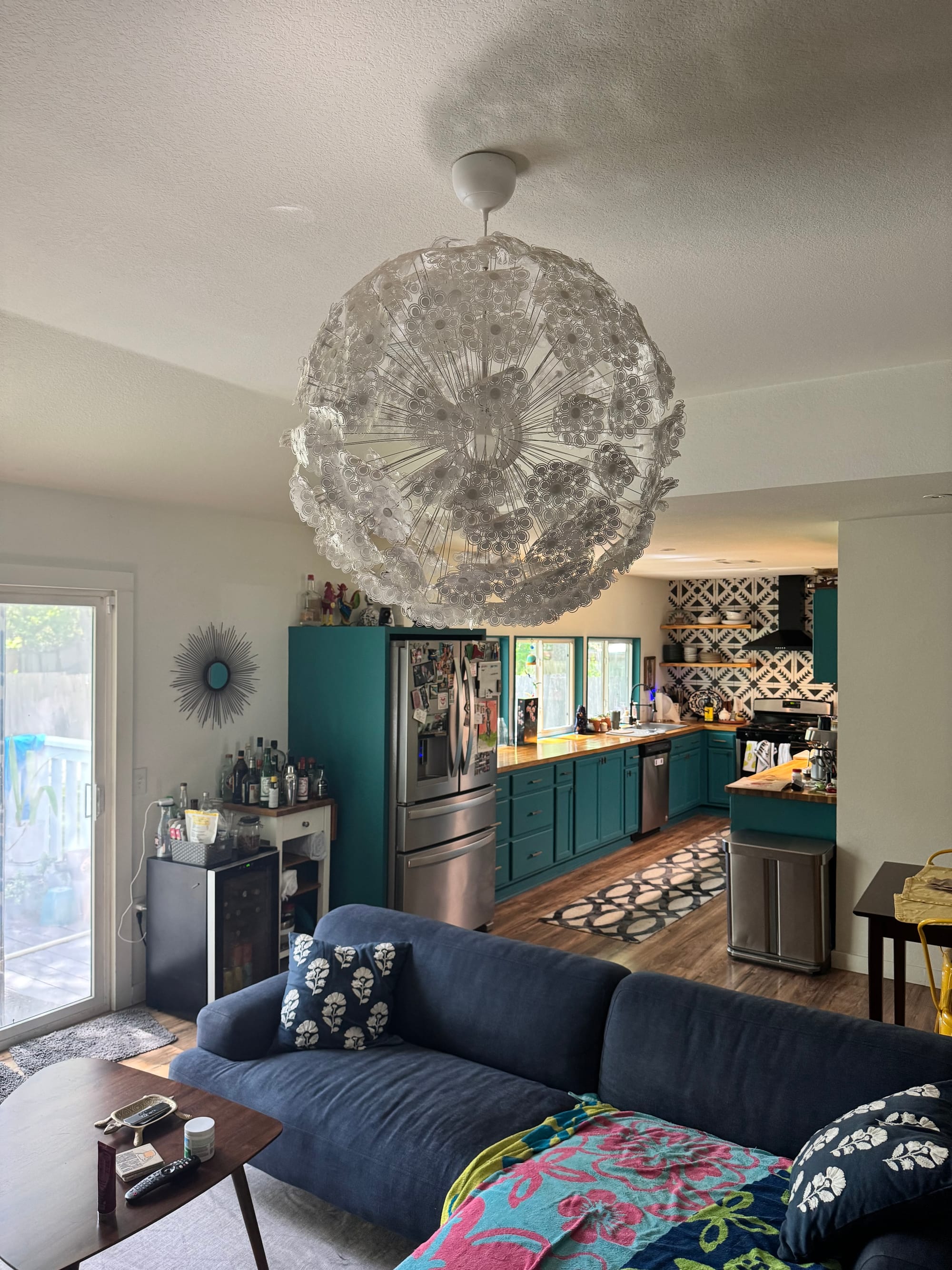
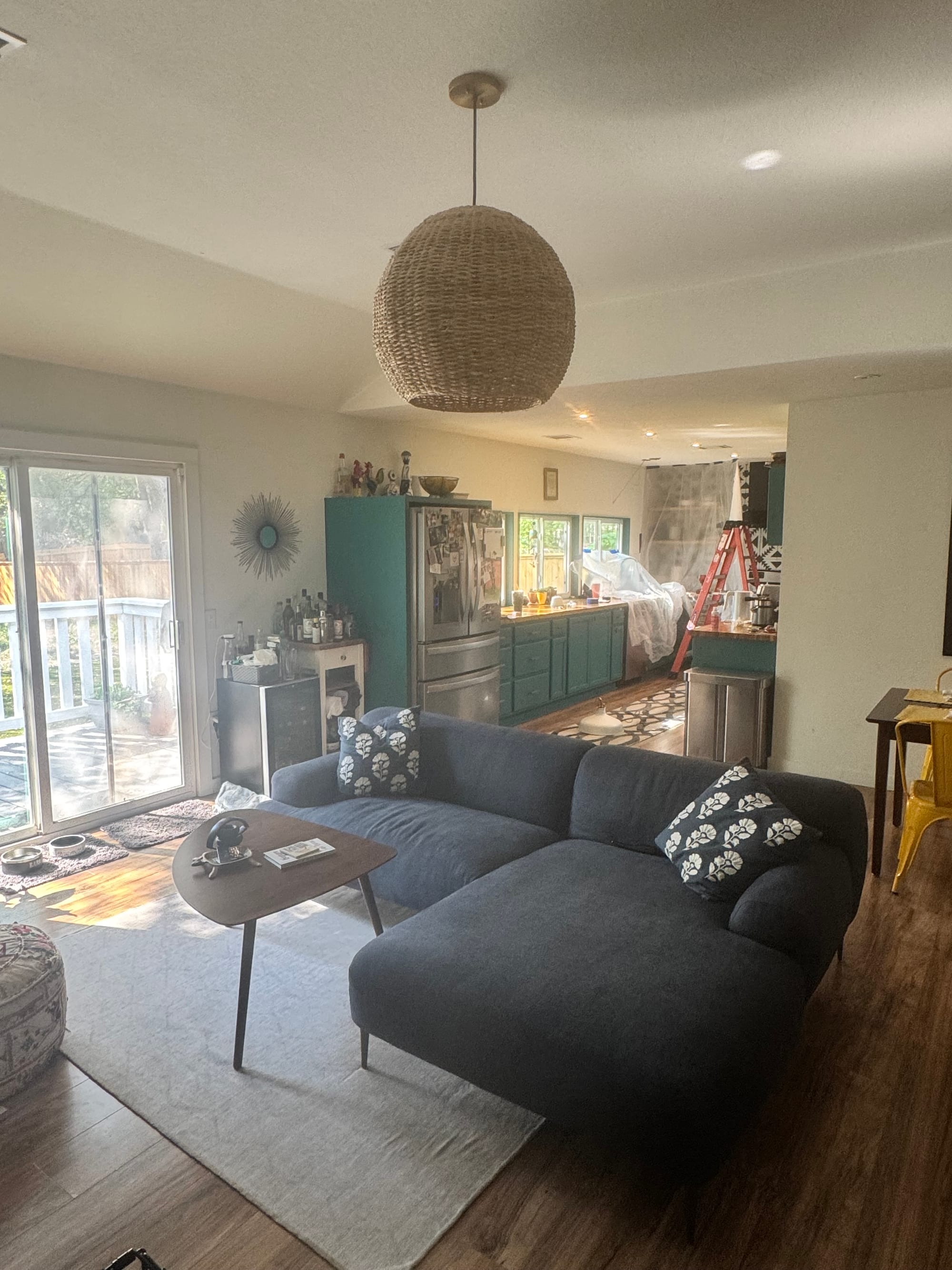
Coronavirus light be gone!
Thanks to all who sent me notes last week; it was truly a joy to hear from you! Thanks for making my inbox something I delighted to spend a few more moments in. Please keep them coming — and if you have a photo or article or book or song that brings you small relief, please send it to me along with a few lines on what you loved about it. With your permission, I'd love to share it more widely here.
Thanks and love to all!
xo/az