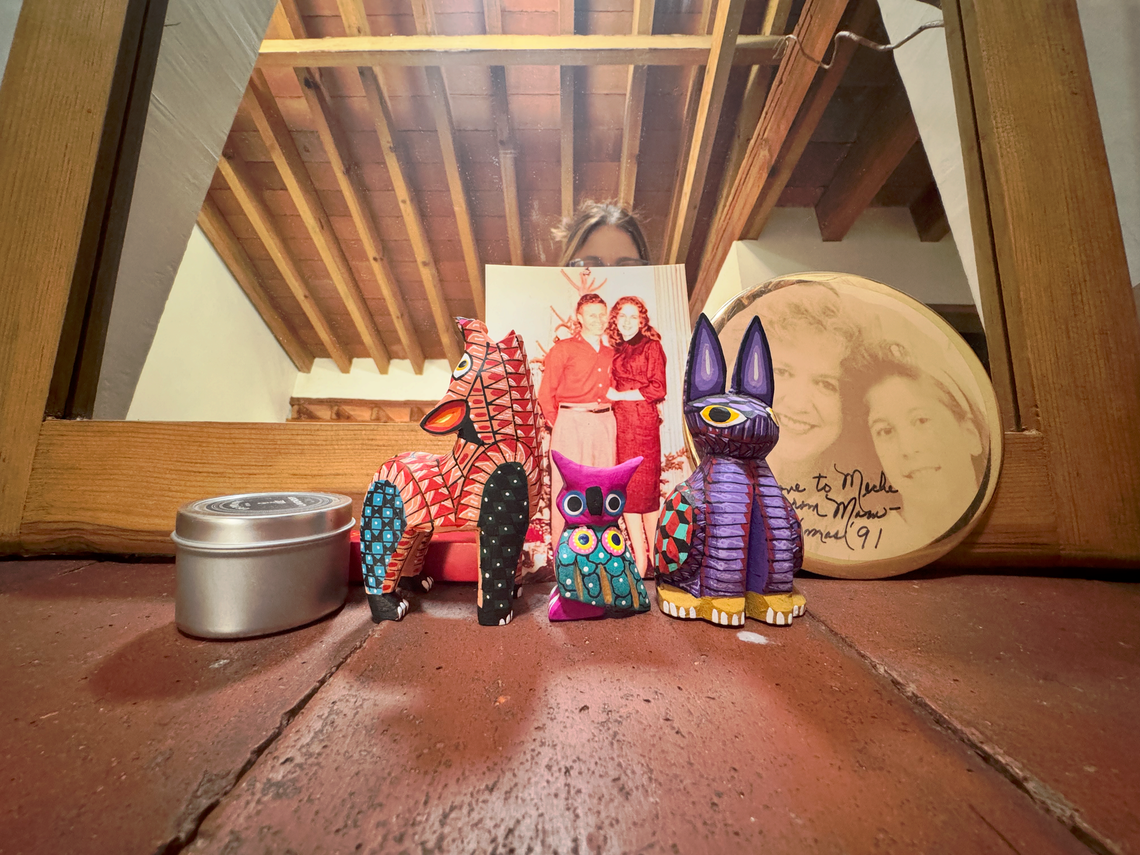
paper trails
It's Thursday. Cam flew home Monday morning, my residency started Tuesday, and I'm still getting used to the size of the room without him in it — Pocoapoco, if you don't know it, is a small nonprofit here in Oaxaca that exists to give artists, writers, makers and thinkers time and space to develop their work alongside one another. Mine started with two days of nothing on the calendar but the thing I actually came here to do, which turns out to be harder to sit down and start than I expected. So, in the spirit of easing in, let me first tell you about the week Cam and I had before any of that.
We made a friend, Javier, who spent a couple days driving us out into the valleys around the city so we could see, up close, how families here have been making organic textiles and mezcal and other artisan goods — not for a generation or two, but for centuries, in some cases for thousands of years, the same techniques handed down mother to daughter, father to son, for long enough that "tradition" feels like too small a word for it. We also got to meet the grandson of Manuel Jiménez Ramírez, the artisan generally credited with originating the alebrije — those colorful carved creatures you'd recognize from Coco.
In Arrazola, we discovered our tonas — a Zapotec animal guardian, assigned to you at birth, that's meant to share something of your nature. Cam's is a chameleon. Mine is an owl. Make of that what you will (I have thoughts!). I'll save the rest of what I'm learning about the sheer diversity packed into this one Mexican state — the languages, the biomes, the mezcal!, the traditions that don't repeat from valley to valley — for a later dispatch.
This one is about the actual reason I'm here, which is a much harder thing to describe than “artist residency in Oaxaca” implies. I came here to start writing through my mother's life, and I arrived not entirely sure how a person does that when the story is so complicated, and so incomplete. So many of the people who could fill in the gaps are gone. And the ones who aren't were often unwilling, or unable, to say much about it while they still could. My dad falls into that second category — reluctant, or maybe genuinely unable, to go very deep when I asked him things, though I'll always give him credit for sitting through the asking.
What I didn't expect, and am only now really ready to receive, is the gift he left behind. When he died, he left piles — literal piles — of papers, letters, albums and artifacts that I am just now coming to sort through. It is a vast history of maternal and paternal heritage: Handwritten letters from the 1800s. Border crossing papers. Photographs signed by starlets I have yet to identify. And, most useful to me this week, my mother's high school notebooks, yearbooks and letters. I've spent these first days here contemplating her life from 1950 to 1960 — when she went from a girl to a teenager to a young woman, in Texas. Next week I move into 1984 to 1994, her last decade with us, starting with the first trip I ever took with her to Mexico City and ending with her death.
There's so much to process just from these first few documents — but for now, I thought I'd share something fitting this space: a dispatch from one of my mother's own trips to Mexico. In 1951, not long after her own father died, she chronicled a visit to see her Tía Mary (her father's beloved sister) in Mexico City. Reading it now, from inside another very clamorous Mexican city, felt like its own small relief — proof that whatever else is unknowable about her, this, at least, survived: her voice, dry and specific and very much intact.
I'll let her tell it, exactly as she wrote it, yankees and all 😉:
We have all been in Texas for sometime and have become somewhat accustomed to Texan driving. It is nothing new or especially wild to us, but when you find yankees in Texas and hear them complaining, one of the things is our driving. “They have never seen more people who don't know how to drive.” “They just don't know where we got our license — forged probably.” To these yankees & some Texans whom will find making similar statements, I say — try Mexico.
When I did in 1951 I was one shocked Texan. We got to Mexico City and as soon as we rested, my mother was ready to begin touring. This was my first sample of Mexican driving, which proved quite an ordeal. I got quite a good sample, for when touring, my mother loves to walk and take the city buses.
I noticed that they do have policemen, but I can't help but wonder why. He stands on a platform in the middle of the street and adds color to the city, for no one pays attention to him. Whoever gets there first gets across first, and if not — well.
The lights seem more like all year Xmas decor, for no attention is paid to these either. Personally, maybe the switch from the donkey to the car was just too fast for them and they don't know what to do with the speed.
In all you can see, the position of the pedestrian is a dangerous one. If you step off the curb as you do here waiting to walk, you may be sorry. You might discover yourself riding on the outside of the car.
Even more so if you go there without any car dodging practice. You either run across the street or inch your way across, and look out if you are doing the latter. The Mexican people seem to be more maniacs at driving than we are.
So, if you care to be safe in Mex. City, practice dodging here. We aren't as good as they are, but we give pretty good competition here in Texas and you’re sure to learn fast or take the consequences.
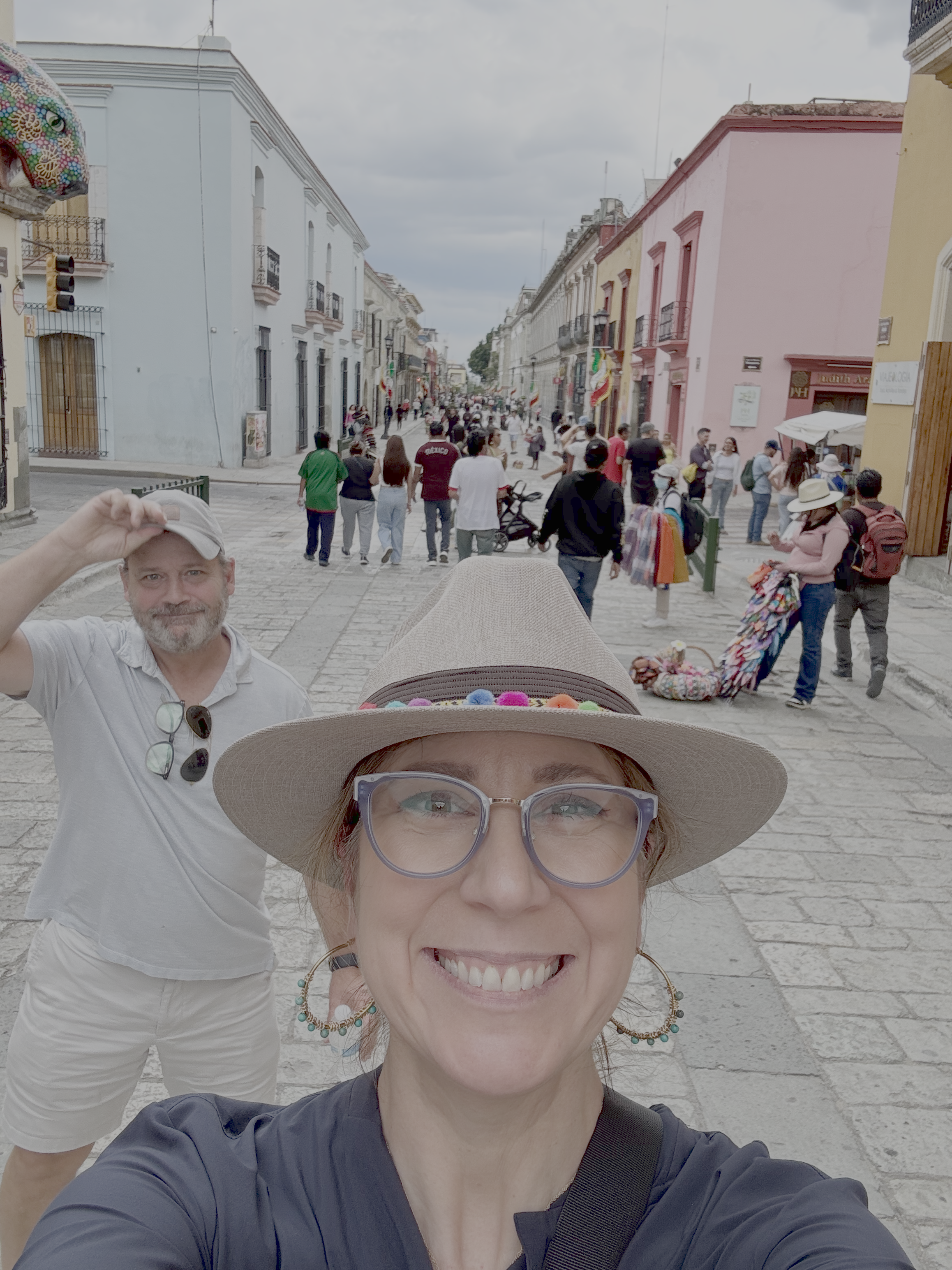
For the record, I think Cam agrees with my mother — I’m not sure we’ll be driving in Mexico any time soon. Here are a few more snaps from our first week — more soon!
More photos from Oaxaca here: https://photos.app.goo.gl/RfDyBWDGm2MG5eDP7
Love to all, from Oaxaca,
az